Näytetään tekstit, joissa on tunniste UNESCO World Heritage. Näytä kaikki tekstit

torstai 4. heinäkuuta 2019

Prague is ruined by tourists

Prague castle at sunset, seen from the Charles Bridge. I'm neither first nor last tourist to take this picture.
(Of course it is not actually ruined. Proceed to read this completely).

Hordes of barbaria tourists overwhelm cities like VeniceDubrovnik and Prague. year after year, and there's a reason for that (or, countless reasons). The three places, and many others, are fascinating and beautiful, each with their own unique character. In each of them I have, however, felt the need to contemplate whether there are too many of us visitors - I am, naturally, aware that I myself am part of the problem.

When is somewhere ruined by tourists? The best answer I can think of is: when the presence of  unsustainable numbers of tourists destroys what originally drew them there. For example, the charm of Prague is, well, that it's Prague: a unique, incredibly beautiful historical city (and, of course, Czech beer). Prague is not an outdoor exhibition of old architecture, but a living city with its citizens. However, it may cease to be that, if tourists displace the actual inhabitants, and it seems to me that, at least in some parts of Prague, this may be happening.
Charles Bridge. Not the rush hour.
For example, in the triangle bordered by Old Town Square, Josefov and Charles bridge, there is no other activity than tourism-related services: there are no groceries or things that local inhabitants need for their daily lives. Only tourist-oriented restaurants, shops selling Chinese-made plastic poop souvenirs, 24-hour Thai massage parlours, and absinthe bars.

The tourist hordes have almost completely displaced the local citizens from one of the beloved symbols of the city, the Charles Bridge. Inhabitants of Prague tend to avoid it and take a detour over Manes Bridge or Legionary Bridge instead. Charles Bridge is often so congested by tourists that it literally is difficult to cross, and there is a very real danger of being accidentally whacked by someone's seflie stick (seriously, leave them home and use, for example, a stretched-out arm instead).

As stated, I am part of the problem, and I don't want to urge anyone to avoid Prague or even Charles Bridge (hey, look at the picture on top of this post). However, if you can help it, visit the city at some other time than late July or early August, because then everyone else is there, too.

I visited Prague in July and August 2018, and previously twice on the 20th Century.

lauantai 21. lokakuuta 2017

Driving in Clouds


If you're headed from, say, Atlanta or New Orleans towards Washington DC or New York (or vice versa) you can, instead of boring Interstate Highways, drive almost a thousand miles of beautiful and slow mountain roads. The Great Smoky Mountains National Park is in the Southern end of the route, the  Shenandoah National Park in the North. They are connected by a scenic mountain route known as the  Blue Ridge Parkway.

When within the clouds, you don't really see the scenery, but it may still be beautiful.
We drove about half of those mountain miles in early June 2017. As you can see from the video above, the weather was not really favorable, except towards the end of the journey. We had also planned a tight-ish schedule. We occasionally headed down from the mountains to the Interstates in the valleys, where it's possible to travel a lot faster. It was also a matter of safety: the winding mountain roads are a little scary if the visibility is poor, especially considering the abundant wildlife. We saw deer, wild turkeys, opossums (we suppose), and one rattlesnake. When darkness falls, it is better to drive on an illuminated highway than in the dark mountain roads - an even better idea is to reach your destination before sunset.

Deer in the Great Smoky Mountains National Park.
As usual in the USA, things have been made easy for a car tourist. There are vantage points every few miles, and a lot of differnet sights to see, so many that even the most duty-conscious tourist can't possibly visit them all (and some of the sights are, how should I put this, questionable). We recommend Museum of the Cherokee Indian in Cherokee, North Carolina, just south of Great Smoky Mountains, and the Mabry Mill, a cute open-air museum in southern Virginia, as well as Monticello, home of Thomas Jefferson, the third president of the United States and the author of the Declaration of Independence (I'm planning on writing more about Monticello later). There are hiking trails and other opportunities to experience the Great Outdoors, but we drove past them, because of the schedule and couch potatoness.

Like many Native American peoples, the Cherokee smoked tobacco in this kind of stone pipes, often in their ceremonies.
The Cherokee played a ball game they called the "Little Brother of War" with sticks like this. The exhibition in the Cherokee Museum is quite impressive, including a presentation of the "Trail of Tears" (or, literally, "The Road on which They Wept"), the forced transfer from the traditional Cherokee lands to Oklahoma, where most of the Cherokee still reside.
The green Mabry Mill is fairytale-like, at least in June.
We do not recommend Pigeon Forge, Tennessee at the southern end of the route, not to travelers like us anyway. There are most bizarre Las Vegas-like plastic tourist traps, such as the half-scale half a Titanic, including the Iceberg. Traveling on mountain roads may be slowed down by not only weather but also traffic jams, especially during the holiday season and on weekends. The route is quite popular and tens of millions of people live nearby.
Titanic. Well, half a Titanic. And the Iceberg.


Huge motor homes, towing "rescue boats", are frequently seen on U.S roads. Many are much larger than this one seen at a Blue Ridge Parkway picnic area.
Like most US National Parks, Shenandoah charges an admission fee, but there are no road tolls or charges on the Blue Ridge Parkway and The Great Smoky Mountains National Park is free of charge. Practically, the only way to experience the route is a car (or, of course, a motorcycle or such), your own or rented. At least in the summer season, it is possible to reach some places in the The Great Smoky Mountains National Park by public transport.

We drove on the Blue Mountains from June 4th to 6th 2017.

tiistai 11. heinäkuuta 2017

People in Israel

I like to take pictures. I also like people-watching. However, I generally do not enjoy people photography, and I seldom get very good results. Surprisingly, in Israel I did get a few pictures that I consider pretty decent. Maybe it was because everywhere, especially Jerusalem, was so crowded.
A woman looking out of her window in the "White City", Tel Aviv.
Hard-working cooks in a popular Tel Aviv lunch joint. The food they made was tasty.
Birdman, Dizengoff square, Tel Aviv.
Garbage haulers, Jerusalem.
Holy selfie, Church of the Holy Sepulchre, Jerusalem.
A Sniper, Damascus Gate, Jerusalem.
A Camel and a Tourist, Mount of Olives, Jerusalem.
A tourist on Masada (click on the picture for a bigger panorama).
Old Man and a girl and a boy and the sea, Acre.
Three travelers on the Acre Sea Walls.
April-May 2016.

Acre, five millennia of battles

The walls of Acre provide great views over the Mediterranean Sea. 
Acre is a relatively small city on the Galilean coast, in northern Israel. As far as we know, people have lived in the area since approximately 3000 BC. The city and its inhabitants have been cursed with a strategical location. Acre has been conquered, besieged and bombed:
  • by Alexander the Great, about  332 BC
  • by Caliph Umar's army in  636
  • by the Crusaders in 1104
  • by Sultan Saladin in 1187
  • by the Crusaders again in 1191
  • by the Mamluk sultan's troops in 1291
  • by Napoleon in 1799
  • by English, French and Austrian navies in 1840
  • and by many others
Acre is probably most famous for Crusaders, at least in the so-called Western World. The biggest attraction in the town is the Crusader Castle, known as the Citadel. To be precise, only the underground parts date from the Crusaders' time. The Ottoman Empire, who ruled Acre from the 16th Century until the First World War, had a more modern fortress constructed on the foundations of the crusader-built Citadel. The bloody, noisy and gunpowder-smelling history of the city is presented to the visitor by means of modern technology: a device and earphones are given to every visitor, and it automatically explains the history of the site on a chosen language. Films explaining life (and death) in Acre are projected to old walls, and sometimes floors.

The system works, but in my opinion it controlled the visitor's experience maybe too much, limiting curiosity and spontaneous interest. My device worked well, but it seemed that some others experienced malfunctions, which causes annoyance and frustration. That said, I'm sure the museum staff is happy to help and, if needed, exchange a non-functioning device to a working one. The audio clips themselves are well executed. A highlight for me was the story of Napoleon's siege of Acre, presented as a dialogue between a French and an Ottoman soldier.


The king of Jerusalem with his entourage.
.
The Crusaders' bathroom was known as the latrine.
There are many other historical sights in Acre, in addition to the Citadel. A Crusader-built tunnel runs under the city center, a small but charming local history museum is situated in the wall fortifications, and there's a restored hamam spa from Ottoman times. The visitors to the hamam are provided with similar guide devices as in the Citadel. In my opinion, here the application is not as good as in the castle: the deluge of stories and information may feel overwhelming, and the video screens divert attention from the beautiful building and interesting objects.
Bathers in the hamam.
The masseur at work.
Acre is not only about museums. It is fun to get lost on the bazaar alleys, and walk on the city walls, taking in the views of the Mediterranean and the city of Haifa over the bay. The historic center of Acre is surrounded by the sea from three sides, and the breeze often keeps it nicely cool - the Israeli climate is a bit too hot for our northern tastes.
The Blue Mediterranean.
Napoleon's army (if I remember correctly) left this cannon on the Acre walls.
In Israel, nothing is ever far away. It's easy to take a day trip to Acre from Tel Aviv or Haifa by local train. The city is completely different from modern Tel Aviv or sacred and chaotic Jerusalem. One of the fascinating things about Israel is that a different reality is always just around the corner, or not more than a 30-minute train ride away.
The Acre Railway Station is a short walk away from the Old Town. On the way there are, among other things, some eccentric artwork, like these disco deer and storks.
The warlike past of Acre is very visible in the town, as are the tensions of today - there's no escaping them in Israel. But, when sitting in a waterfront restaurant, looking at the turquoise water and an old man teach fishing to his grandchildren, it is easy to forget unpleasant things and, for a moment, to concentrate on the beautiful.
We visited Acre on May 3rd 2016.

lauantai 8. heinäkuuta 2017

Sintra, Castles in the Clouds

Pena palace covered by clouds.
I have visited quite a few castles, and even worked in one. It would be fair to say that I like castles a lot. In Sintra, just outside Lisbon, there are no less than three castles, so I obviously had to go there. In the end I only had time to visit two of them, as their opening hours are limited, less than 12 hours a day.

The Castle of the Moors, Castelo dos Mouros, is the oldest and, to me, most wonderful of Sintra's castles. In fact it's one of the most interesting castles I've ever visited, and it says a lot. It was, as the name implies, built by Arabs, known as moors at the time, who ruled medieval Portugal and Spain, They build their stronghold on top of a steep mountain, to a position easy to defend. The oldest walls are some 1200 or 1300 years old.
The walls of the Castle of the Moors.
In 1147 AD the Moors surrendered to troops commanded by Afonso Henriques, whom the Portuguese consider a national hero. The Portuguese flag has flown over the castle ever since - however, the design has changed several times. Now, many different historical flags fly in the flagpoles. The castle lost its military significance already on the 15th century, and an earthquake damage it on the 18th century. The restauration work started on the 19th century, first paid personally by the king of Portugal. The remaining structures of the castle are very interesting, but best is the dramatically beautiful setting on top of a mountain, above Sintra town. Pictures do no justice to the views.

It's not easy to dig a well in a castle on a mountain top. The crafty Moors solved the problem by building an underground cistern to collect rain water, so that the defenders of the castle would have something to drink even when under siege.
Near the Castle of the Moors, on a slightly higher mountain top, stands the Pena Palace. It is not nearly as old, the palace was built in mid-19th Century, but it incorporated some structures from an earlier convent building. It was originally the king's summer residence. It is quite a patchwork of architectural styles, and the richly decorated rooms create an impression of a castle in the clouds - and the palace is indeed frequently covered by clouds. When the 1910 revolution deposed the last king of Portugal, the palace was converted to a museum.


There is one more castle in Sintra, known as the National Palace, Palácio Nacional de Sintra. It, too, is originally built by the Moors, but the present appearance date from 14th and 15th centuries when the Portuguese kings resided there. Unlike the Castle of the Moors and Pena Palace, the National Palace is situated in the center of Sintra town. One day would probably be enough time for most visitors to visit all three castles, but I spent so much time in the two mountain castles that the National Palace closed before I got there. I admired it from the walls of the Castle of the Moors.

Kansallinen palatsi.
There's more to Sintra than the castles. It may not be a bad idea to spend two days there. Travel time from Lisbon is about an hour by suburban train, and tickets are very affordable. The mountain castles can be reached from Sintra station by bus or taxi. It is possible to walk, too, but it cannot be recommended to day-trippers whose time is limited. A budget traveler who stays in Lisbon should either eat in Lisbon or come equipped with a picnic lunch: Sintra is very popular among both Portuguese and foreign visitors, and that shows in cafe and restaurant prices.

I visited Sintra on July 3rd 2014.

torstai 22. syyskuuta 2016

Holy Chaos


Today is the Good Friday of Eastern Christianity, and countless Christians wander all around the city in the footsteps of Jesus.
Today is the seventh day of the Passover, and countless Jews wander to the Western Wall to pray.
Today is Friday, the holy day of Islam, and countless Muslims wander to the mosques.
The salesmen, who serve no other master than Capital - at least when their shops are open - part everyone of their money, the believers and non-believers alike.
There's a sniper positioned in a window above the Damascus gate. He looks like he's about 19 years old.
On the other side of the gate there's a small cafe, with a picture of the Patriarch of Alexandria on the wall. Under his gaze the owner serves everyone, his Muslim neighbors, Finnish tourists, Ethiopian pilgrims an Israeli soldiers alike, in the same loud and friendly way, like his ancestors did when the Ottomans, or the Crusaders, or king Solomon ruled the city.
A most endearing old English gentleman welcomes us to the site of Jesus' grave. This is a different place from the other Jesus' grave we visited yesterday. There the monks took selfies with their cellphones in the Holy Sepulchre.
Slogans are chanted on Nablus road - a riot! Should we run away? Where to? But it is not a protest after all, just a shopkeeper, even louder than the others.
On the Western Wall children are more interested in chasing the pigeons than in the fact that they are in the focal point of the most volatile political crisis in the World.
In the evening three young men haul garbage on a cart, powered only by their muscles, shouting and joking at each other and passersby, past shops that sell overpriced trinkets to pilgrims, exactly like other young men did two thousand years before them.
The waiters in an Armenian restaurant are wearing t-shirts with a picture of suffering Christ, the Crown of Thorns on his head.
In the city museum there is a small Egyptian clay statue, more than 3000 years old. It bears an inscription: "Cursed be Jerusalem".


Jerusalem, April 29th 2016

lauantai 29. elokuuta 2015

The Canyon

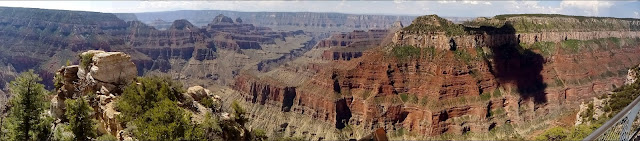
Bright Angel Point, the first part of the Canyon we saw. Click this to see the full-sized panorama picture.
In Northern Arizona, the Colorado River has in the course of about 17 million years carved a really, really big hole in the ground. The Grand Canyon is 1857 meter (6093 feet) deep, 29 kilometer (18 miles) wide, 447 kilometer (277 miles) long and makes you feel very, very small.
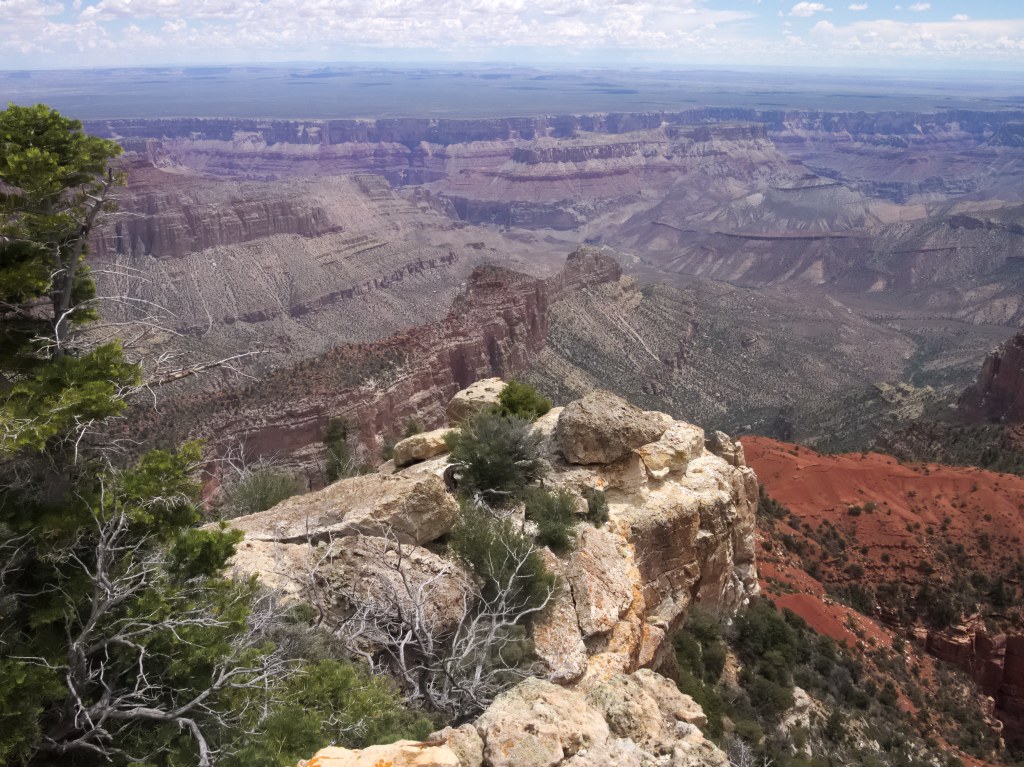
Point Imperial, the highest point on the Rim.
Panorama of Point Imperial. Full-sized picture is here.
Today the Grand Canyon is one of the most popular tourist destinations of the World. It gets approximately 5 million visitors every year, which is funny to us, because that's also roughly the population of Finland. About 4,5 million only visit the southern rim of the canyon. This was one of the reasons we decided to visit the North Rim. It was crowded enough, too, even though we visited in June, before the busiest summer season. (A friend recommended North Rim, for which we're thankful. Thanks again, Ruth.)
A lot of wildlife can be seen in and near the Canyon, there are even bisons. We only saw deer and lizards.
The scenery in Grand Canyon is unbelievable. I found myself wondering if it actually is real, or a great hoax made with powerful computer graphics and advanced 3D projection technology?
Angel's Window vantage point. I think the name refers to the hole in the rock, visible on the right.
A baffling thing about the Grand Canyon is that in many places it would be easy to walk some 20 meter (60 feet) from the Rim without knowing that the Canyon is there. As we were driving on the scenic roads, there often was a forest on one side of the road, not unlike the forests in Finland, and a vertical half-mile drop on the other.
The view from Angel's Window pictured with a fisheye lens.
We spent one full day on the Canyon. That was enough to visit several vantage points in a relaxed pace. We also had time for a lunch in Grand Canyon Lodge. Food was good and not as horribly overpriced as I would have expected.

Walhalla vantage point.
Perhaps the most impressive thing we saw was the Grand Canyon sunset, observed from the balcony of the Lodge. We were smart enough to capture first-row seats early. The light and colors changed constantly as the sun descended. The view left us (but not the American tourists) speechless. The sunrise would probably be equally impressive, but since in June it takes place before 6 am we missed it.

The last rays of the setting sun.
In January, almost six months before our trip, I tried to book us a room on the North Rim within the National Park. Everything was fully booked. We ended up staying in Jacob Lake resort. Confusingly, there's no lake anywhere near it. The drive to the Canyon Rim took about one hour each way. When we returned, in the dark after sunset, things got a little scary. There were a lot of deer crossing the road, and even a cow and a calf. There was even a warning sign for bisons, but thankfully we saw none on the road.

A white-tailed Kaibab Squirrel in Jacob Lake. This kind of squirrel only lives near the North Rim of Grand Canyon. Squirrels on the south are different subspecies: the Canyon is an unbridgeable obstacle for squirrels.
We found Jacob Lake a nice place to stay. Prices were a little high, but so they are everywhere near attractions like Grand Canyon. Our cabin was comfortable, and the resort has a shop, a restaurant and a bakery. Chocolate and raspberry cookies get our highest recommendation. As experiences go they rival the Grand Canyon sunset. The cookies alone make Jacob Lake worth a stop! Sunset Amber Ale brewed by a local brewery was tasty.

The breakfast was not included in accommodation prices but featured lovely American-style pancakes with sponge like texture, so that they can absorb ridiculous amounts of delicious maple syrup. Those fortunate enough to have experienced an American breakfast know what I mean. Jacob Lake also offers lectures on things like landscape photography and history of the Navajo around Grand Canyon. Unfortunately we didn't have time to attend any.

We visited Grand Canyon on June 13th 2015.