Traveling is coffee for the soul.
There are many astonishing and wonderful things in the world, and I like to travel and see them. I am a middle-ageish man and I live in Northeastern Europe. My wife often travels with me, voluntarily. All pictures are taken by me, unless otherwise indicated.
John A. Roebling bridge connects Cincinnati, Ohio and Covington, Kentucky, here pictured from Kentucky side.
A few years ago I attended a conference in Cincinnati, Ohio. Afterwards I had a few days off, and spent an afternoon visiting the neighboring city of Covington, Kentucky, across the river from Cincinnati, easily accessed by crossing a bridge. While I didn't see any particularly memorable sights in Covington, my visit was... unforgettable.
Right after crossing the bridge I met my first Kentuckian. He was apparently homeless and dressed in a full, jolly red and very, very dirty Santa Claus costume, including the hat. The beard seemed to be natural, not part of the costume. It was September, and the temperature was 29C (84F).
Then, I noticed a small clothes shop advertising affordable T-Shirts, and as I needed some I bought a couple. The saleswoman, a lady much younger than myself, addressed me as "Sweetheart". My American friends tell me this is polite and not exceptional, but it surely is not something I've learned to expect in Finland.
At this time I concluded that I needed a beer. Thankfully, I just came across a pub. The bartender not only asked to see my ID (I was in my early 40s at the time), but also offered me a job in the pub. Being a foreign visitor with no work permit in the States, I declined. This was a couple of months before the 2016 US presidential election, and after learning that I came from Finland he burst into a monologue - I would describe it as a fiery sermon - about (mostly) Donald Trump and how he would sell America to Vladimir Putin, if elected. I tipped him generously.
I drank, of course, a local beer: Kertucky Old Fashioned Barrel Ale, recommended!.
Blueberry pancakes, jam, maple syrup, coffee and grapefruit juice. Cincinnati, Ohio, 2016.
The United States is in many ways a controversial nation. There are lots of incredibly awesome places and things, but also huge problems and dark shadows of history present in the society. I know that some people wonder, whether they should travel there at all. I warmly recommend a visit to the US for everyone who has the opportunity. There are countless reasons to go there, but here, I only concentrate on one, which alone is easily reason enough to visit America.
The breakfasts.
An omelette, rosemary potatoes, bisquit ("bun" for most Europeans, I think), jam, coffee and grapefruit juice. Memphis, Tennessee, 2017.
Often, the United States thinks that it is the best, greatest and first of the World. Considering breakfasts, this indeed is the case.
Even at worst, American breakfast is better than other breakfasts. Pancaces, maple syrup, scrambled eggs, bacon, sausages, French toast, coffee and orange juice. San Francisco, California 2015.
The American breakfast is usually constructed around pancakes, waffles or French toast. Eggs, sausages or bacon are often served with them - but only imagination sets the limit (I've seen a breakfast menu featuring T-bone steak served with pancakes). Serving sizes are such that those used to modest European breakfasts will easily manage until late lunchtime, or longer. As the United States is a very multicultural nation, there are countless local and cultural variations of the American breakfast, such as blue corn pancakes served by the Zuni in New Mexico - recommended!
Texans have, of course, over-Texasified the breakfast, too. A waffle shaped like the map of Texas. San Antonio, Texas 2017.
Nothing in this world is perfect, not even the American breakfast (even though it gets close). It is not the epitome of healthy eating, as there generally is a lot of sugar and fat. Thankfully, lighter options are usually available, as is fresh fruit. And, although the American coffee is sometimes very good, it often isn't. Luckily there usually is enough of it, breakfast often includes unlimited coffee.
The Field of Angels, a memorial to enslaved children who died in their infancy.
Can you even begin to imagine, what it would have felt like if, when you were five years old, you would have suddenly been taken away from your family and friends, it would have been explained to you that you have been sold to a new owner who will take you far away and you will never see your parents and siblings again?
Me neither. Thank God.
Countless people, however, have experienced such things, and worse: the slaves. Whitney Plantation is one of the best places to try and understand the sinister and repulsive history of American slavery. It is one of the many tourist-oriented plantations by the Mississippi between New Orleans and Baton Rouge. Whitney is, however, the only one of those whose point of view is not that of the rich owners but that of those on whose work the wealth was based on - the enslaved.
The beautiful gardens of the plantations bear few traces of the horrors of the past.
In my opinion, museums at best can help visitors better understand things, to make history more real to them. I think Whitney Plantation does a good job in this. I already knew most of the facts the guide and exhibitions told me, but the visit helped me to better understand those facts. Of course, there is - thankfully - no way for me to completely understand what the slaves really experienced and felt.
Unlike most other plantations, the visitors are first taken to the miserable slave cabins, only later to the prestigious big house.
Even more than the violent and savage treatment of the enslaved - which, of course, is horrific - I felt disgusted by the complete denial of their humanity. The enslaved were cynically treated like merchandise, or pack animals, or machinery. The practice I find most repulsive was the breeding of human children for merchandise. An enslaved person was an expensive investment, worth a lot of money for the owner. Therefore, it was in the plantation owners' interests to produce more enslaved people, for their own use or to be sold. This was generally not very difficult, as anyone born to an enslaved mother was automatically considered a slave. Who the father was, did not matter. Consequently many enslaved women had to live, or die, as breeding machinery: they may have had more than ten children, many of whom were sold or otherwise taken from the mothers at a very early age. Enslaved men and women may have been forced together, on the peril of violence, to produce offspring. If an enslaved woman failed to have children by other means, the owner may have raped and impregnated her himself, and consequently place his own children in a position comparable to that of cattle or machinery, or merchandise. These cases were not exceptional at all.
There are statues of enslaved children on the Whitney Plantation. This one depicts Anna, who was given as a house pet - our guide indeed used the word "pet" - to the childless woman who owned the plantation at the time. Later, at 14, Anna gave birth to her first child, whose father was the middle-aged brother of her owner.
A visit to the plantation always includes a guided tour, explaining the gruesome everyday life on a slave plantation: hard work, in Whitney's case on sugarcane fields, as usual in Southern Louisiana, often on cotton field in more Northern parts; many enslaved workers could not stand the inhumane working conditions alive for more than a few years. The guide described the violence, the awful food, the unworthy living quarters. In the exhibitions, there are many oral history quotes from 1930s interviews with Americans who were born enslaved. They are used to give voice to those who were so often silenced. There are several books based on the interviews, and some have been used in a documentary film.
A quote from the 1930s interview with Hannah Chapman, who was born enslaved.
The visit to Whitney Plantation made an enormous impression on me, even though as a Finn I feel no direct connection to the history and legacy of American slavery. I can only imagine what the visit is like for the descendants of enslaved African-Americans, or the white slave owners. From New Orleans, the visit takes a few hours: we left the city after breakfast and were back for late-ish lunch. I consider the time well spent. If you don't have an access to your own or rented vehicle, there are tours by bus, which may include visits to other places, too.
John Cummings, the founder of Whitney Plantation museum. He told that his goal was not to promote guilt but understanding: "Those responsible are in Hell, if you believe that".
One of the highlights of the tour was a chance encounter with John Cummings, the current owner of the plantation and the founder of the museum. Mr. Cummings, a retired lawyer, is a very good speaker and gave us an interesting account of the founding and goals of the museum. Sometimes, in American public debate, it is asked should the African-Americans not be able to leave the legacy of the slavery behind, as it was abolished 150 years ago. According to Cummings, this sentiment is based on unfamiliarity and inadequate understanding of the realities of slavery. That's why he says: "I, personally, will no longer be content to live in ignorance. Do not ask the question, 'why can't they get over it', unless you know what the 'it' is".
In the video below Cummings and other staff at Whitney Plantation share further thoughts and information.
We visited the Whitney Plantation on May 24th 2017.
Washington DC, the capital of the United States, was intentionally designed to impress visitors. It does. The city is full of monuments to various events in American (and some non-American) history - there are many more than those covered here.
National World War II Memorial, Washington Monument in the background.
Probably every war the USA ever fought has a memorial. Interestingly, they seem reflect the perception of these wars in American public consciousness. The National World War II Memorial is a victory parade sculpted in Marble, a homage to the enormous strength of the United States. No human characters are depicted, only laurels of victory accompanied by names of battlefields.
Korean War Veterans Memorial.
The Korean war was not as obvios a victory for The US. The Korean War Veterans Memorial made a great impression to me, because, as I understand it, it depicts the soldiers as not only heroes but also victims. The faces of very lifelike statues seem, at least to me, depict the fear, anguish and confusion those who fought must have felt.
Vietnam Veterans Memorial. I wondered if this couple was looking for a particular name - perhaps a brother, a friend, a schoolmate? Their generation supplied the soldiers who fought in Vietnam.
The Vietnam War ended over 40 years ago, but for many Americans it still is a difficult, controversial and divisive matter. At best, it is seen as an embarrassment and a failure, at worst, an imperialistic raid the United States should never have participated at all. It hardly is surprising, then, that the opinions on Vietnam Veterans Memorial are divided, too. The monument consist of nothing but black stone walls, bearing inscribed names of all American military personnel who died in Vietnam in 1959-1975, orderd by time of death. The opponents have called the memorial "a nihilistic slab of stone", among other things: on the other hand, it has been included on a top 10 -list of American architecture.
Washington Monument.
Many presidents have their memorials as well. The most visible one is - unsurprisingly - the 169-meter (555-feet) obelisk erected in honor of the first president, George Washington. In a way, it is also a memorial to setbacks. The construction began in 1848, but was stopped in 1854 due to lack of funds. It took 25 years before it resumed. An embarrassing stub stood right in the center of the capital city, visible from the president's White House. The break is visible in the completed Monument, as the marble used in early stages was sourced from different quarries than the stones used later. Consequently, the lower third is of a lighter color than the rest of the obelisk. In 1885, the monument was finally completed. At the time, it was the tallest building in the world. The troubles did not end there: recently the monument was damaged by an earthquake in 2011, and has been closed to the public since 2016 because of elevator malfunction.
Jefferson Memorial.
Jefferson himself.
The monument to Thomas Jefferson is a cupola-topped building, in which third president and the author of the Declaration of independence stands as a larger-than-life-sized statue. The walls are inscribed with quotes from his writings. At the time of our visit, there was a demonstration going on in front of the monument. Apparently, this is not exceptional. This time the demonstrators were motivated by issues related to health care.
Abraham Lincoln.
The site where Martin Luther King gave his "I have a dream" speech is marked on the stairs of the Lincoln Memorial.
Abraham Lincoln, who presided over the victory in the Civil war, who freed the slaves and who died by the bullet of an assassin, is probably the second most admired president among the Americans, after George Washington. No surprise then that his monument is quite impressive, too. It looks a little like a Greek or Roman temple and houses a larger-than-life statue of Lincoln. The Lincoln memorial, too, has seen numerous demonstrations. One of the most famous is the 1963 March for Jobs and Freedom, best remembered for Martin Luther King's "I have a Dream" speech.
All monuments mentioned above are situated relatively close to each other along the National Mall. They can easily be explored on foot, but the monumental cale of Washington DC may be deceptive. Lincoln Memorial, for example, may seem to be right next to World War II Memorial, but they are actually about half a mile apart.
In addition to wars and presidents, there are monuments to many others, like scientist Albert Einstein, but I still couldn't figure out the theory of relativity.
We visited the monuments of Washington DC in May and June 2017.
....walk in the French Quarter (and Marigny, and Treme, and elsewhere).
...go paddlewheeler-watching on the riverfront.
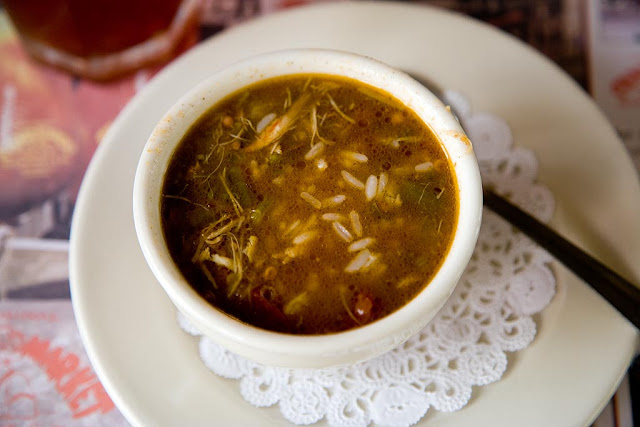
...eat gumbo, eat red beans & rice, eat po'boys, eat beignets, and, well, eat. Recommended places includeDooky Chase's,Gumbo shopandCoop's place, but it seems that there is no way to get bad food in the city. We ate everything before thinking of taking pictures, so this bowl of gumbo is from Wikimedia Commons. Picture by Elliot Lowe (CC BY 2.0).
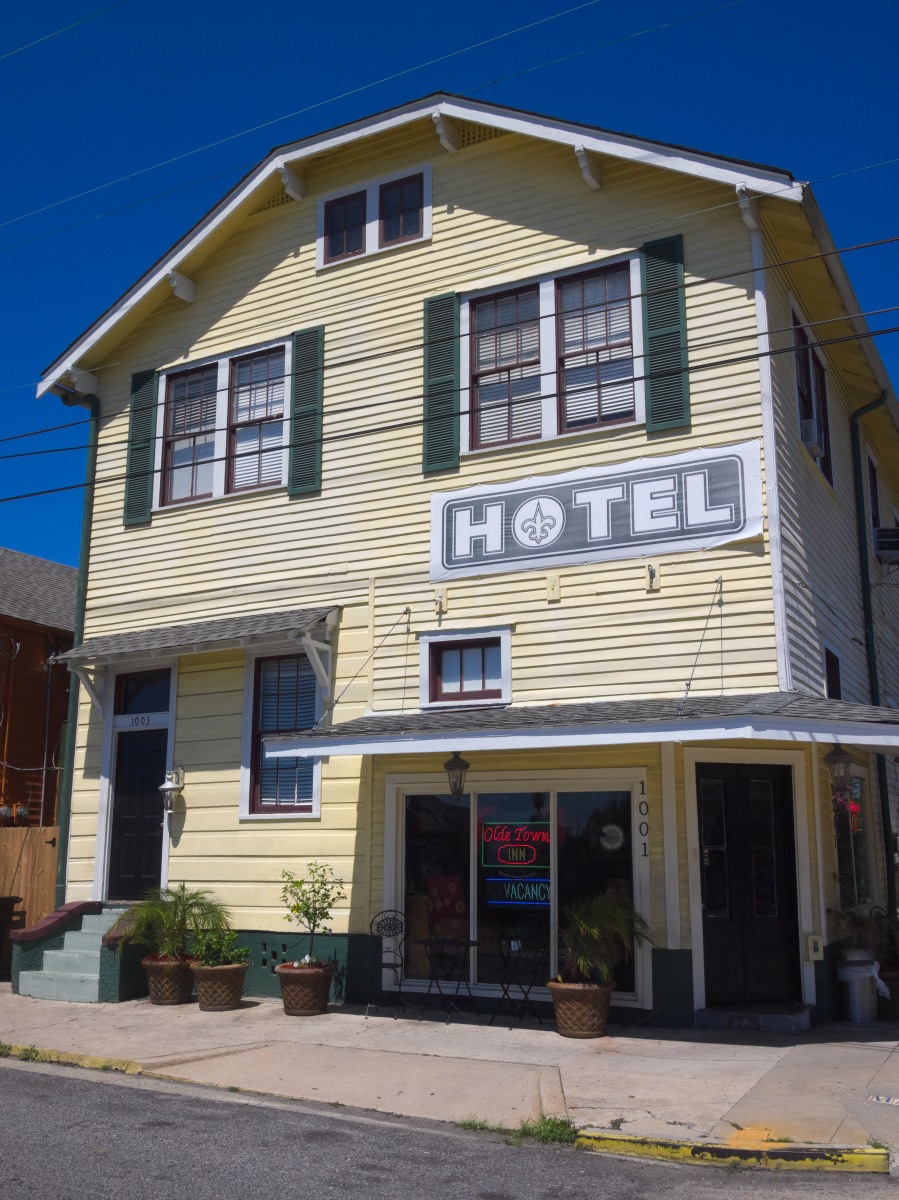
...stay in an old New Orleans house, like inOlde Town Inn as we did.
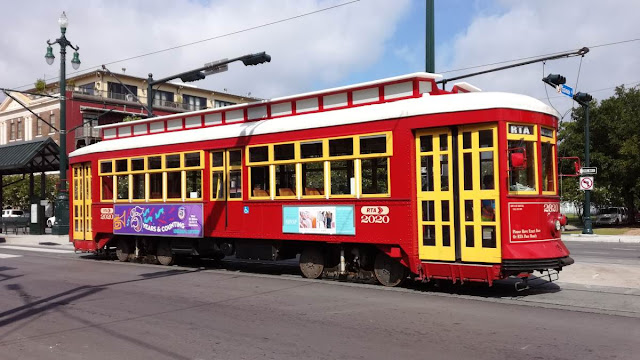
...ride streetcars.
...and go to Bourbon Street like everyone else, at least briefly.
If you're headed from, say, Atlanta or New Orleans towards Washington DC or New York (or vice versa) you can, instead of boring Interstate Highways, drive almost a thousand miles of beautiful and slow mountain roads. The Great Smoky Mountains National Park is in the Southern end of the route, the Shenandoah National Park in the North. They are connected by a scenic mountain route known as the Blue Ridge Parkway.
When within the clouds, you don't really see the scenery, but it may still be beautiful.
We drove about half of those mountain miles in early June 2017. As you can see from the video above, the weather was not really favorable, except towards the end of the journey. We had also planned a tight-ish schedule. We occasionally headed down from the mountains to the Interstates in the valleys, where it's possible to travel a lot faster. It was also a matter of safety: the winding mountain roads are a little scary if the visibility is poor, especially considering the abundant wildlife. We saw deer, wild turkeys, opossums (we suppose), and one rattlesnake. When darkness falls, it is better to drive on an illuminated highway than in the dark mountain roads - an even better idea is to reach your destination before sunset.
Deer in the Great Smoky Mountains National Park.
As usual in the USA, things have been made easy for a car tourist. There are vantage points every few miles, and a lot of differnet sights to see, so many that even the most duty-conscious tourist can't possibly visit them all (and some of the sights are, how should I put this, questionable). We recommend Museum of the Cherokee Indian in Cherokee, North Carolina, just south of Great Smoky Mountains, and the Mabry Mill, a cute open-air museum in southern Virginia, as well as Monticello, home of Thomas Jefferson, the third president of the United States and the author of the Declaration of Independence (I'm planning on writing more about Monticello later). There are hiking trails and other opportunities to experience the Great Outdoors, but we drove past them, because of the schedule and couch potatoness.
Like many Native American peoples, the Cherokee smoked tobacco in this kind of stone pipes, often in their ceremonies.
The Cherokee played a ball game they called the "Little Brother of War" with sticks like this. The exhibition in the Cherokee Museum is quite impressive, including a presentation of the "Trail of Tears" (or, literally, "The Road on which They Wept"), the forced transfer from the traditional Cherokee lands to Oklahoma, where most of the Cherokee still reside.
The green Mabry Mill is fairytale-like, at least in June.
We do not recommend Pigeon Forge, Tennessee at the southern end of the route, not to travelers like us anyway. There are most bizarre Las Vegas-like plastic tourist traps, such as the half-scale half a Titanic, including the Iceberg. Traveling on mountain roads may be slowed down by not only weather but also traffic jams, especially during the holiday season and on weekends. The route is quite popular and tens of millions of people live nearby.
Titanic. Well, half a Titanic. And the Iceberg.
Huge motor homes, towing "rescue boats", are frequently seen on U.S roads. Many are much larger than this one seen at a Blue Ridge Parkway picnic area.
Like most US National Parks, Shenandoah charges an admission fee, but there are no road tolls or charges on the Blue Ridge Parkway and The Great Smoky Mountains National Park is free of charge. Practically, the only way to experience the route is a car (or, of course, a motorcycle or such), your own or rented. At least in the summer season, it is possible to reach some places in the The Great Smoky Mountains National Park by public transport.
We drove on the Blue Mountains from June 4th to 6th 2017.
I am not what you would call a culinarist. I like good food as much as the next person, but as a rule, I concentrate on other things when travelling, and do not like to invest a lot of time in finding places to eat. Consequently, I often end up eating some kind of fast food, That said, I try to avoid international chains and eat at places ran and frequented by locals, when at all practical.
However, this does not (always) mean that the food I eat is bad. On the contrary, often fast, affordable and tasty are served on the same plate. Here are a few highlights I've encountered.
Tima-Irma, Mostar, Bosnia and Herzegovina
The hungry of Mostar, locals and tourists alike, have found their way to Tima-Irma ever since the days of Marshal Tito, and been hungry no more. As always in Herzegovina (and Bosnia, as well as in Croatia and Montenegro), Čevapčići is excellent, and so is everything else. Prices are reasonable. Tima-Irma also serves tasty local beer, which is not easy to find.
Look for this sign on Onešćukova street, east from the Bridge.
Tima-Irma may be my favorite of all, and I have recommended it to many fellow travelers. They all have loved it and spread the word. I may have accidentally started a cult. We have eaten at Tima-Irma in 2009 and 2012.
El Farolito, San Francisco, California, U.S.A.
This place, situated in the corner of Mission and 24th, serves burritos that may change your life. As a lot of other people want to eat there too, prepare for queues and chaos. The process of ordering and serving at El Farolito may be confusing for first-timers. First, one queues to the counter, where the orders are placed and paid. There one receives a slip of paper with a number on it, and beverages (I recommend one the Mexican fruit sodas), Then one tries to find a seat, or, if all seats are taken, remains standing wherever there is room. Soon, a waiter will be walking up and down the aisle, shouting numbers in Spanish and English. One should listen for the two last numbers on the slip received at the counter (it's a 5-number code but the first three don't matter). Note that there is no logical connection between the numbers and the order in which the food is served: if one has, for example, a slip ending in 56, the previous one may be 33, 48 or 71.
Somehow I failed to take any pictures in El Farolito, so this is from Wikimedia Commons, by Rick Audet of San Francisco.
Any inconveniences are forgotten when the food arrives - it is indescribably good. San Francisco is in general expensive, but Farolito's prices are reasonable. It serves some exotic (for North Europeans) specialties, like tongue burritos. The uninitiated, like me, may find some Mexican foods extremely spicy. I recommend Quesadillas: the cheese balances the burning chili peppers nicely.
It should be mentioned that the waiter in El Farolito is, at the time of writing, only person who has ever addressed me as "bro". We ate in El Farolito in June 2015. Twice.
The sausage stand with the green bunny, Vienna, Austria
We visited Vienna very briefly. We were tipped by a local about a sausage stand behind the Opera House. It was a good tip.
The green bunny is easily recognized .
There are about a dozen different kinds of sausages. We tried Waldviertel and Red Bratwurst. Both were excellent. I recommend local märzen beer, but you can splurge on a bottle of real Champagne if you feel like it. Prices are reasonable: we paid less than 10€ for two sausages and two beers.
San Francisco is known as the focal point of the hippie movement, and I'm told one should wear flowers in the hair there. We didn't, and few residents seem to do so either. The hippies seem to have disappeared. They are not to be found even the symbolic center of the "Summer of Love" in 1967, Haight-Ashbury district, which was not our favourite place in the city. Fortunately, the City by the Bay is full of other interesting places. I've already blogged about some of them.
Golden Gate bridge
The 1300 meter (4200 ft) bridge, completed in 1937, spanning the Golden Gate Strait is probably the best known symbol of San Francisco. It is visible from many places around town - unless there is fog, which may be the second best known symbol of San Francisco. We recommend crossing the bridge by foot, the views of town, Alcatraz and other places are great. Biking the bridge seems to be popular too, but we didn't try that. There are numerous bicycle rental shops in the city, and they also provide maps and route suggestions.
The name Golden Gate refers not only to the bridge but also to the strait the bridge spans. When the bridge was built, the U.S. Navy demanded it should be painted in yellow and black instead of red, for better visibility.
There are telephones on the bridge, with direct access to crisis counseling. There is no doubt this is a good thing, but it is a shivering thought nevertheless.
Mission
Mission is one of the most interesting districts of San Francisco. The name refers to a mission the Spanish founded in 1776, Mission San Francisco de Asís, after which the whole city was named. Today many residents of the district are of Latin American descent. Spanish seems to be at least as widely spoken as English.
Mission is known for its murals.
Thia mural pays tribute to Salvadoran bishop Óscar Romero, who spoke out against poverty and injustice and was murdered while offering mass in 1980.
Mission San Francisco de Asís is also known as Mission Dolores. Its church is the oldest building standing in the city.
Mission is an excellent neighborhood for a meal. Like many others, we recommend the El Farolito on the corner of Mission and 24th, right next to a metro station. We ate there twice, the food was excellent and service speedy and friendly ("what kind of meat for you, bro?") even though the place was unbelievably crowded (which seems to be a permanent state of affairs).
Ferries
The fastest and most practical connection between San Francisco and Oakland, on the Eastern shore of San Francisco bay, is the BART suburban train. However, in good weather we recommend taking the ferry instead. Also Sausalito and Tiburon, to the North of the Golden Gate, are accessible by ferry from San Francisco.
The historical Ferry Building still serves as the ferry terminal ofFrancisco.
We recommend buying lunch and/or ice cream from one of the Ferry Building's many takeout joints and eating on one of the nearby piers (pay attention to seagulls, though).
Bisons were hiding from the heat in shade and I didn't get any proper photos of them.
Street climbing
San Francisco is famous from steep hillside streets.
Yes, steep.
Twin Peaks is not only a TV series, it is also a viewpoint in San Francisco.
Dark Side
San Francisco is no paradise. Every big city, and many small ones, have their problems. On the streets of San Francisco live an alarming number of homeless people, many of them clearly with severe substance abuse problems. The homeless are more numerous, or at least more visible, than in New York, London or Berlin, for example. One of the first San Franciscans we met was smoking pot in a park at 8 AM, having a lively conversation with someone visible only to him.
The slums of the underprivileged and the city's most prestigious properties are sometimes right next to each other. An example of this is the beautiful park in front of the City Hall, with pathways clean enough to serve a meal on. The grim, depressing district of Tenderloin literally begins one block away from the park. There the overfilled, unemptied trashcans spill their contents on the streets, the homeless are sleeping under bus top benches and a repulsive smell of urine hovers over everything. I have not witnessed such a steep contrast in wealth anywhere in the so-called Western World. The closest comparison that I can think of is Tbilisi.
Oakland, across the Bay and a 10-minute train ride away from San Francisco, is statistically the violent crime capital of California and one of the most dangerous cities in United States. However, there's statistically no reason to get hysterical. We stayed in the infamous West Oakland for a week, and not once did we feel threatened in any way.