Näytetään tekstit, joissa on tunniste Vertigo. Näytä kaikki tekstit

maanantai 10. syyskuuta 2018

Tatra, or Couch Potatoes in the Mountains

Mountain landscapes of Štrbské pleso.
I probably have stated this before: we are no sportspeople. We will walk considerable distances in cities or maintained paths, but leave more demanding activities like, say, mountain biking, to others. The High Tatras - Vysoké Tatry in Slovakian - is a very suitable mountain destination for people like us. Of course, there's plenty to do there for hikers and mountaineers, too, but I am not the one to write about that.

The High Tatras are the highest part of the Carpathian mountains, and are divided by the border between Slovakia and Poland: the highest peaks of both countries are there. Most importantly the High Tatras are incredibly beautiful, whether viewed through a train window from the valley below or from the top of one of the mountains. See:

Tatra seen from the city of Poprad.
Lomnický štít (2634m, left) and Kežmarský štít (2588m, right) seen from Skalnaté pleso.
What makes the High Tatras particularly suitable for couch potatoes is the TEŽ, Tatra Electric Railroad. It has taken travelers up to the mountains from the city of Poprad for more than a century. A day ticket, allowing one to travel as much as one manages within a day, was 4€ in July 2018.

A TEŽ train in Tatranská Lomnica.
We stayed in Poprad, and took the train to the village of Štrbské pleso. The original plan was to get off at Popradské pleso and walk to Štrbské pleso from there - there apparently is a non-demanding hiking path connecting them. However, we changed our plans because the weather forecast promised rain and we knew that in Štrbské pleso we would not be too far from shelter. There was no rain. On the edge of village, there is a picture-postcard-beautiful mountain lake, around which there is a well-maintained, easy path.
The lake is surrounded by mountains.
Štrbské pleso - few vowels, plenty of views.
Hotel Panorama, the weirdest piece of socialist architecture in Štrbské pleso village.
The high point of our visit to Tatra  was a cable car ride to the top of Lomnický štít, 2634 meter above sea level (pun entirely intended). It involves no less than three cable cars. First is a small and scary one from Tatranská Lomnica to an intermediate station, where you change to a fancy and modern one, which in turn takes you to the Skalnaté pleso mountain lake. From there you continue in a tiny, completely terrifying cable car to the top. Even if you are, like us, afraid of heights, I warmly recommend it because of the incredibly amazing views. Being a sea-level dweller, I felt quite dizzy, not sure if it was because of vertigo or altitude sickness.

Up on the top we were almost swallowed in a cloud.
The light up high is different, or at least feels so.
We were advised to book the cable car tickets as early as possible. Since I didn't get the online booking system to work, we went quite early on a Sunday to inquire about tickets. The next available ones were for Monday afternoon. This was in late July, just as the busiest summer season in Central Europe was beginning. Weekends may be more busy. If you can't get tickets all the way up to Lomnický štít, or if you're unwilling to pay the undeniably steep price of 49€ per person for return ticket, consider taking tha cable car to Skalnaté pleso only. Advance bookings are not necessary there, and Skalnaté pleso with has beautiful views, reasonably-priced restaurant and some easy hiking paths. It's worth braking your journey there anyway, either going up, coming down, or both.

With the exception of  Lomnický štít cable car, the general price level in Tatras is pleasantly low compared to most of Europe: 10€ buys a good meal, with drinks, in most restaurants, the very tasty Slovakian beer is usually less that 2€ a pint, and even accommodation is affordable. We paid less than 30€/night for a room for 2, with bathroom, in Poprad.

We visited the High Tatras in July 27th to 31st 2018.

lauantai 8. heinäkuuta 2017

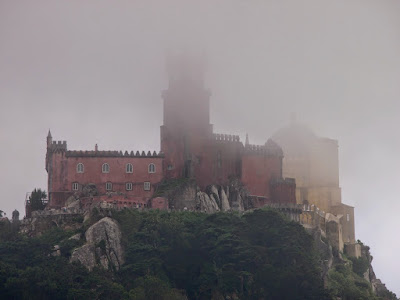
Sintra, Castles in the Clouds

Pena palace covered by clouds.
I have visited quite a few castles, and even worked in one. It would be fair to say that I like castles a lot. In Sintra, just outside Lisbon, there are no less than three castles, so I obviously had to go there. In the end I only had time to visit two of them, as their opening hours are limited, less than 12 hours a day.

The Castle of the Moors, Castelo dos Mouros, is the oldest and, to me, most wonderful of Sintra's castles. In fact it's one of the most interesting castles I've ever visited, and it says a lot. It was, as the name implies, built by Arabs, known as moors at the time, who ruled medieval Portugal and Spain, They build their stronghold on top of a steep mountain, to a position easy to defend. The oldest walls are some 1200 or 1300 years old.
The walls of the Castle of the Moors.
In 1147 AD the Moors surrendered to troops commanded by Afonso Henriques, whom the Portuguese consider a national hero. The Portuguese flag has flown over the castle ever since - however, the design has changed several times. Now, many different historical flags fly in the flagpoles. The castle lost its military significance already on the 15th century, and an earthquake damage it on the 18th century. The restauration work started on the 19th century, first paid personally by the king of Portugal. The remaining structures of the castle are very interesting, but best is the dramatically beautiful setting on top of a mountain, above Sintra town. Pictures do no justice to the views.

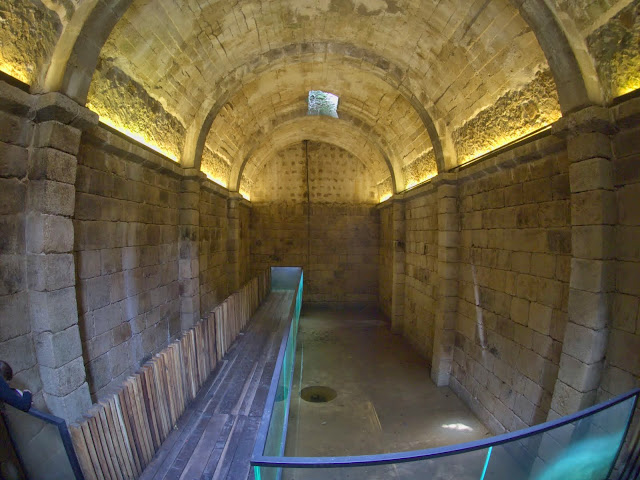
It's not easy to dig a well in a castle on a mountain top. The crafty Moors solved the problem by building an underground cistern to collect rain water, so that the defenders of the castle would have something to drink even when under siege.
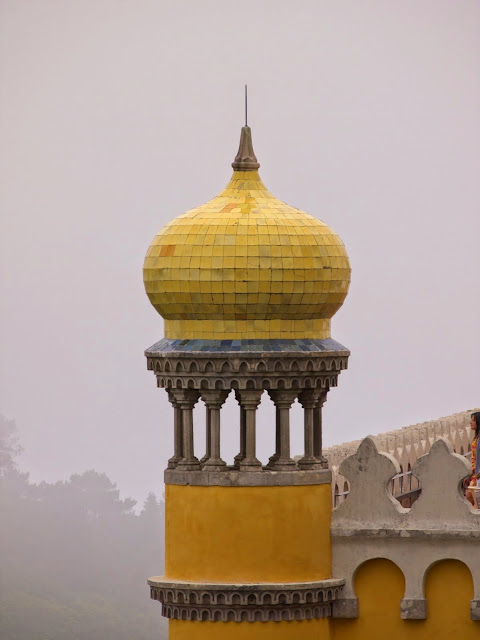
Near the Castle of the Moors, on a slightly higher mountain top, stands the Pena Palace. It is not nearly as old, the palace was built in mid-19th Century, but it incorporated some structures from an earlier convent building. It was originally the king's summer residence. It is quite a patchwork of architectural styles, and the richly decorated rooms create an impression of a castle in the clouds - and the palace is indeed frequently covered by clouds. When the 1910 revolution deposed the last king of Portugal, the palace was converted to a museum.
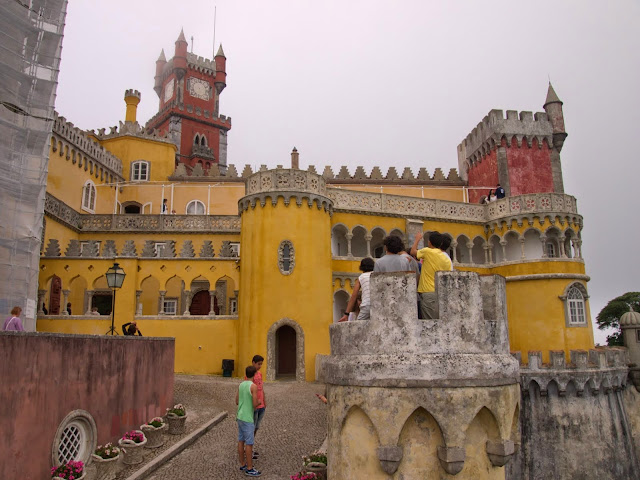
There is one more castle in Sintra, known as the National Palace, Palácio Nacional de Sintra. It, too, is originally built by the Moors, but the present appearance date from 14th and 15th centuries when the Portuguese kings resided there. Unlike the Castle of the Moors and Pena Palace, the National Palace is situated in the center of Sintra town. One day would probably be enough time for most visitors to visit all three castles, but I spent so much time in the two mountain castles that the National Palace closed before I got there. I admired it from the walls of the Castle of the Moors.

Kansallinen palatsi.
There's more to Sintra than the castles. It may not be a bad idea to spend two days there. Travel time from Lisbon is about an hour by suburban train, and tickets are very affordable. The mountain castles can be reached from Sintra station by bus or taxi. It is possible to walk, too, but it cannot be recommended to day-trippers whose time is limited. A budget traveler who stays in Lisbon should either eat in Lisbon or come equipped with a picnic lunch: Sintra is very popular among both Portuguese and foreign visitors, and that shows in cafe and restaurant prices.

I visited Sintra on July 3rd 2014.

lauantai 10. syyskuuta 2016

What to do in San Francisco with no flowers in the hair

San Francisco is known as the focal point of the hippie movement, and I'm told one should wear flowers in the hair there. We didn't, and few residents seem to do so either.  The hippies seem to have disappeared. They are not to be found even the symbolic center of the "Summer of Love" in 1967, Haight-Ashbury district, which was not our favourite place in the city. Fortunately, the City by the Bay is full of other interesting places. I've already blogged about some of them.


Golden Gate bridge
The 1300 meter (4200 ft) bridge, completed in 1937, spanning the Golden Gate Strait is probably the best known symbol of San Francisco. It is visible from many places around town - unless there is fog, which may be the second best known symbol of San Francisco. We recommend crossing the bridge by foot, the views of town, Alcatraz and other places are great. Biking the bridge seems to be popular too, but we didn't try that. There are numerous bicycle rental shops in the city, and they also provide maps and route suggestions.
The name Golden Gate refers not only to the bridge but also to the strait the bridge spans. When the bridge was built, the U.S. Navy demanded it should be painted in yellow and black instead of red, for better visibility.
There are telephones on the bridge, with direct access to crisis counseling. There is no doubt this is a good thing, but it is a shivering thought nevertheless.
Mission
Mission is one of the most interesting districts of San Francisco. The name refers to a mission the Spanish founded in 1776, Mission San Francisco de Asís, after which the whole city was named. Today many residents of the district are of Latin American descent. Spanish seems to be at least as widely spoken as English.
Mission is known for its murals.

Thia mural pays tribute to Salvadoran bishop Óscar Romero, who spoke out against poverty and injustice and was murdered while offering mass in 1980.
Mission San Francisco de Asís is also known as Mission Dolores. Its church is the oldest building standing in the city.
Mission is an excellent neighborhood for a meal. Like many others, we recommend the El Farolito on the corner of Mission and 24th, right next to a metro station. We ate there twice, the food was excellent and service speedy and friendly ("what kind of meat for you, bro?") even though the place was unbelievably crowded (which seems to be a permanent state of affairs).

Ferries
The fastest and most practical connection between San Francisco and Oakland, on the Eastern shore of San Francisco bay, is the BART suburban train. However, in good weather we recommend taking the ferry instead. Also Sausalito and Tiburon, to the North of the Golden Gate, are accessible by ferry from San Francisco.
The historical Ferry Building still serves as the ferry terminal ofFrancisco.

We recommend buying lunch and/or ice cream from one of the Ferry Building's many takeout joints and eating on one of the nearby piers (pay attention to seagulls, though).
Golden Gate Park
There are bisons, the De Young Art Museum and a Japanese Garden (and more) in the largest park of the city.
 De Young Museum
Japanese garden.

Japanese garden.

Bisons were hiding from the heat in shade and I didn't get any proper photos of them.
Street climbing
San Francisco is famous from steep hillside streets.
Yes, steep.
Twin Peaks is not only a TV series, it is also a viewpoint in San Francisco.
Dark Side
San Francisco is no paradise. Every big city, and many small ones, have their problems. On the streets of San Francisco live an alarming number of homeless people, many of them clearly with severe substance abuse problems. The homeless are more numerous, or at least more visible, than in New York, London or Berlin, for example. One of the first San Franciscans we met was smoking pot in a park at 8 AM, having a lively conversation with someone visible only to him.

The slums of the underprivileged and the city's most prestigious properties are sometimes right next to each other. An example of this is the beautiful park in front of the City Hall, with pathways clean enough to serve a meal on. The grim, depressing district of Tenderloin literally begins one block away from the park. There the overfilled, unemptied trashcans spill their contents on the streets, the homeless are sleeping under bus top benches and a repulsive smell of urine hovers over everything. I have not witnessed such a steep contrast in wealth anywhere in the so-called Western World. The closest comparison that I can think of is Tbilisi.

Oakland, across the Bay and a 10-minute train ride away from San Francisco, is statistically the violent crime capital of California and one of the most dangerous cities in United States. However, there's statistically no reason to get hysterical. We stayed in the infamous West Oakland for a week, and not once did we feel threatened in any way.

We visited San Franciscossa in June 2015.