Näytetään tekstit, joissa on tunniste Pueblo. Näytä kaikki tekstit

sunnuntai 3. huhtikuuta 2016

Not the Seven Cities of Gold

There's no such a concentration of ancient pueblo buildings in Zuni as in, for example, Acoma, but there are some traditional Adobe structures..
In late 16th century the Spanish had subdued most of present day Mexico under their power. For some reason, a rumor about Seven Cities of Gold began to spread among them. They were supposed to be found in the North, across a great desert. The first one to look for them was Francisco Vásquez de Coronado, who, however, never found them. Neither did anyone else, even though many have followed him during the centuries.

In New Mexico and Arizona we visited same parts where the Spanish conquistadors centuries earlier spread war, horror and destruction in their search for the Golden Cities. We didn't find any Cities of Gold, but seven places well worth visiting.

1. Inscription Rock Trading & Coffee Co
A recently shorn alpaca outside the cafe.
On our long drive from Acoma to Zuni Pueblo I felt an urgent need to drink coffee. Let's be honest: the coffee served in service stations in Finland is usually not good at all. However, it is far better than the disgusting goo that most roadside cafes in the U.S. torment their customers with. Of course, in big cities very good coffee is available, but now we were pretty close to Nowhere, New Mexico. I was fully prepared ensure my adequate caffeine intake with some disgusting, watery liquid.

Just east of El Morro National Monument (see below) we ran into a very pleasant surprise: a very nice couple serving excellent coffee in a most pleasing environment. In addition, outside the cafe there were two llamas and an alpaca.

2. El Morro National Monument
Steep walls of El Morro.
The summers of New Mexico are hot and dry. Historically, drinking water has been in short supply. A rock known as El Morro shelters the only water spring within miles. It is hardly surprising that passers-by have stopped here to fill their water containers for centuries, perhaps millennia.

In addition, the ancestors of the present-day Zuni built a small town on top of the hill in the 13th century. Archaeological evidence suggests that the settlement was abandoned relatively soon, even before the Spanish conquest. The inhabitants of that town did start a tradition that has continued to our days: making inscriptions in the soft sandstone of El Morro,
Ancient petroglyphs by the ancestral puebloans.
The Spanish embraced this tradition. Their first inscriptions date from early 17th century. The rock wall carries boastful descriptions of "pacification" of the pueblo peoples and other conquests. Some more modest travelers only inscribed their names, the date and the words paso por aqui, "passed by here". When the English-speaking Americans reached New Mexico in 19th century, they continued the tradition of inscriptions. Today, El Morro is a National Monument run by the National Park Service. As always, NPS does an excellent job providing information about the site and keeping the infrastructure in shape.
Boastful Spanish inscriptions.
El Morro spring.
3. Zuni Pueblo
The Zuni are an extraordinary people. Their language seems not to be related to any other language known to mankind, They are known, among other things, for their colorful and intricate ceremonies which combine a thousands of years old understanding of the Universe and the powers influencing it with Roman-Catholic christianity taught to the Zuni by the Spanish.

Earlier the Zuni have inhabited a vast area in several villages and towns. It is possible that the stories about "Cities of Gold" referred to their and other pueblo people's dwellings. After the Pueblo revolt of 1680 and the subsequent return of the Spanish most of the Zuni have lived in Zuni Pueblo, in western New Mexico.

The traditions of the Zuni have been a subject of active ethnographic research, and a number of books have been published on the subject. The Zuni have not always been too happy about it. At least some Zuni people think that some of their ceremonies are not meant to be observed by outsiders. Perhaps this is the reason that the Zuni are exceptionally reserved about photography. All photography within the pueblo is subject to permission, and for example inside the church no photography is allowed at all. However, photography is the only thing the Zuni are reserved about, they are equally as welcoming and friendly as other Americans.

Zuni Pueblo is not an impressive and beautiful place in a similar way as, for example, Acoma Pueblo. Old adobe buildings have disappeared, with the exception of the church (see below). The small but well-run A:shiwi A:wan -museum gets my recommendations. We were told that Zuni Pueblo is one of the best places for shopping for authentic Native American made arts and crafts. However, we didn't do any shopping, due to restrictions imposed by our schedule, budget and the airline luggage weight limits. The fuel prices were lowest we saw on our road trip.

4. Our Lady of Guadalupe Church
The church, built in 1629, was almost in ruins for a long time. It was renovated in 1960s.
I have visited quite a number of different churches. The Roman Catholic mission in Zuni Pueblo, built by the Spanish in 1629, is one of the most peculiar. Its walls are decorated with colorful murals that depict the traditional ceremonies of the Zuni. Reportedly, there were similar paintings already a long time ago, but the original ones were destroyed, when the church was abandoned for years. In 1970 Alex Seowtewa, a Zuni artist, decided to paint new murals. The project took several decades, but now there are murals depicting the Zuni winter solstice ceremonies on the northern wall, and summer solstice ceremonies on the southern wall.

The church can only be visited with a guide. We had the good fortune to get Ken Seowtewa, Alex Seowtewa's son, to present the church for us. He had helped his father in painting the walls, and had a lot of stories to tell and a wealth of information to share about the making of paintings (he even pointed out a Star Trek connection) and symbolism involving them, the history of the church and the culture of the Zuni. As explained by him, Zuni clan system is approximately similar to the one of the Acoma and the Navajo: the clan membership is determined by the mother. Among other things, the clan system has protected the Zuni from inbreeding, quite contrary to the traditions of European royal families which favored marriages among close relatives. Right after explaining this mr. Seowtewa apologized to us, as we were the only Europeans present. We told him there was no need to apologize, as Finland is a republic!

5. Inn at Halona
Most people who travel by car in the USA probably spend several nights at motels. So did we. Most motels are well kept and provide good value for money. However, the motels are also very like each other, there's not much to distinguish between them. We recommend trying different kinds of accommodation every now and then.

In Zuni Pueblo, Inn at Halona provides excellent accommodation. The old building has a special feeling to it, and the place is situated right in the center. The prices are only slightly higher than roadside motels, and include a truly remarkable breakfast. We recommend a local specialty, blue corn pancakes.

6. Petrified Forest National Park
Petrified wood.
A whole trunk of a petrified tree.
Long time ago, before the dinosaurs, a dense forest grew in what now is Eastern Arizona. Due to unique geological events, the trees did not molder after the forest died, but they were petrified and turned into jewel-like colorful stone. Nowadays the forest is aptly named Petrified Forest National Park.

A cactus in bloom.
In addition to weird stone trees there are other things to see in the park. About a thousand years ago the ancestral pueblo people built several small towns in the area. They were, however, abandoned already before the first contact with Europeans, probably because of a drought that destroyed their fields, and the inhabitants moved to more fertile parts. There is little left of their buildings, but there are some paintings made by them to be seen in Puerco Pueblo. One of them is said to indicate the exact moment of summer solstice. We visited the place slightly less than 48 hours too early to see that.
We were told the spiral-like symbol in the center of the picture is illuminated by the sun at the exact moment of summer solstice, and only then..
Puerco Pueblo petroglyphs.
Present-day Petrified Forest is not forest but desert. It is known as "Painted Desert" because of the colorful soil. We've visited quite a few places that felt otherworldly, like they were situated on a different planet than our home. This was one of those places.
Painted desert.
"Drove mys Chevy to the levee, but the levee was dry..." - actually, we drove a Hyundai from Budget car rental.
As Petrified Forest is a U.S. National Park, there of course is a well-equipped informative visitor center with a museum and helpful, knowledgeable park rangers. There's an entrance fee, like most National Parks.
This Studebaker broke down on the historical route 66 before the Second World War and has stood in the middle of the desert ever since.
7. Mi Pueblo
On a U.S. road trip it is very difficult to avoid eating in fast food chains. When in Winlsow, Arizona, we recommend Mi Pueblo, an independent restaurant run by a family of Mexican origin. The food  was very tasty indeed, prices were reasonable and atmosphere cozy. Much nicer than most highway-side industrial fast food joints.

We were looking for Seven Cities of Gold on June 18th-19th 2015

Acoma, Sky City

Acoma "main street".
One of the oldest continuously inhabited human settlements in present-day United States, possibly the oldest, Acoma Pueblo, is situated in New Mexico, about 100 kilometers (60 miles) from Albuquerque. The Acoma have lived on top of their table mountain since about 1150 AD. In their own language they call their home Haak'u, "a place prepared".
Acoma seen from the foot of the table mountain.
Acoma is one of 21 pueblos, Native American towns or villages. 19 of them are situated in New Mexico, one in Texas and one in Arizona. Puebloan peoples' cultures have common elements, but they consider themselves separate nations and they speak several different languages.

Acoma is built on top of a table mountain, a place that was easy to defend against neighboring Navajos and Apaches, who sometimes conducted raids to steal crops and cattle. At times, the relations were more peaceful and goods were traded between neighbors. In late 16th century the Acoma were, however, unable to defend their town against the Spanish conquerors' firearms and artillery. In 1599 a Spansh army led by Juan de Oñate destroyed the buildings of Acoma and took 500 prisoners. Women and young men were taken into slavery. The right foot of all grown-up men was chopped off.

The history of the Spanish and the Acoma is bloody. However, the church of  San Esteban del Rey, built by the Spanish in 1629, is a source of pride and a beloved National treasure for the Acoma.
Oñate is considered the founder of New Mexico, but it is hardly surprising that the Acoma do not remember him very fondly. In 1998 a group from Acoma pueblo cut the right foot off a statue of Oñate near the town of Española, New Mexico. I appreciate this kind of civil dispobedience. A more complete account of the events can be read  here. In 1680 Acoma participated in the pueblo revolt, which chased the Spanish out of present-day New Mexico. It took several years before they were able to return. After that, the history of Acoma has been less turbulent.

Today, the historical town of Acoma on top of the table mountain is still inhabited, even though there is no electricity, running water or plumbing. Majority of the Acoma live in modenr buildings nearby - "we like our showers and TV too", as our guide put it. However, every Acoma family still has a house in the old town and most spend at least certain holidays there.

A traditional oven made of clay. According to our guide it can be used for baking pizza.
For a visitor, Acoma provides a very interesting and easy way to learn about an ancient and distinctive way of life. There's a visitor centre on the foot of the table mountain, with a small museum. You can watch a film about the Acoma history there, or in Youtube before your visit (part 1 and part 2). Historical Acoma on top of the table mountain, also known as "Sky City", can only be visited with an Acoma guide. Our guide was, as guides in the U.S. usually are, professional, informative and fun.

Our guide explaining extraordinary entrance arrangements of one of the oldest houses in Acoma.
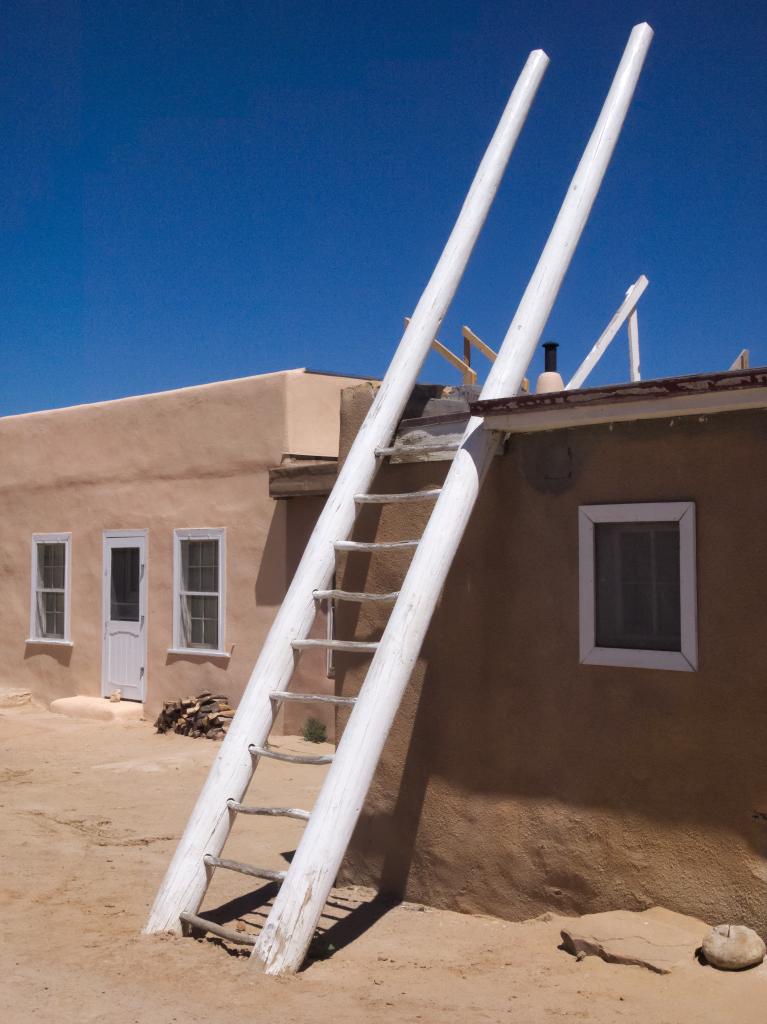
The oldest standing buildings are from 17th and 18th centuries, but even the newer ones resemble traditional adobe structures. Some modern comforts have been adopted. Glass windows were introduced in 20th century, as were street-level doors. The original entrances were situated on the roofs of the buildings and could only be reached by ladders. This, of course, complicated the everyday life, but made it much more difficult for raiders and conquerors to penetrate the buildings.

Kivas, buildings used for traditional ceremonies, are found in all pueblos. They are still accessed by the roof, and most of them are at leas partially underground. In Acoma, the kivas are distinguished by this kind of double ladders.
Every Acoma is a member of one of about 20 clans. The clan is determined by one's mother, and marriages within the clan is not permitted. There are many things associated with clan membership: for example, a ceremonial chief, the cacique, must be from the Antelope clan. Most pueblo peoples, as well as the Navajo, have a clan system resembling that of the Acoma. It is not only clan membership that is passed by the mother: property is, too. Consequently, every building in Acoma pueblo is owned by the oldest woman in the family, who, according to our guide, exercises a significant power in all decisions - "what the grandmother wants, the grandmother gets". According to the Acoma, the society run by old ladies has been proven functional by thousands of years.

Adobe houses.
The top of the table mountain can be reached by a minibus, the ride is included on the tour fee. Those who want to, can walk back down. We recommend this for everyone who is able to. The stairs carved in the rock are steep, and the New Mexican sun may be scorching. On the way down, spare a thought for the Acoma women who for centuries carried all water needed on top of the mountain in clay pots on their heads.
The top of the stairs.
Acoma stairs.
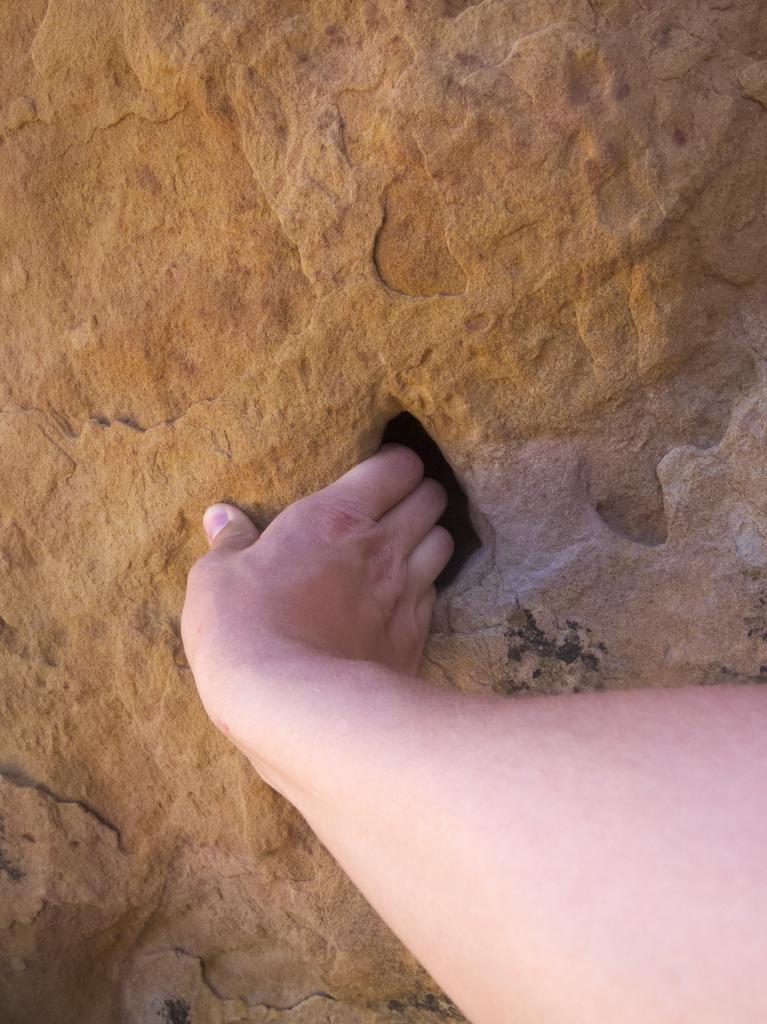
In the steepest places, hand-girps are carved into the rock to assist climbers.
On the visitor center courtyard stands a memorial to Acoma military veterans. In the U.S. military, the proportion of Native Americans is about twice as high as their propotion of the general population. In most Native communities, the military veterans are held in very high regard. I find this very interesting, and a little surprising, considering the violent and bitter history of the relationship between Native Americans and the U.S. government. Probably one factor is the relatively low income level and high unemployment in many Native communities. The U.S. military provides employment opportunities and, for example, education stipends, which would otherwise be very difficult for the less wealthy to obtain.
We very much enjoyed our visit to Acoma and can sincerely recommend it to everyone. The only complaint was excessively hot weather. Acoma pottery is famous, and there are many opportunities to purchase it directly from the makers both in the visitor center and in the town itself. The Acoma are very reserved about photography, taking pictures of people without asking first is extremely impolite. All photography in Acoma is subject to permission, but the guide fee includes a photo permit. Like on most Native American lands, there is a complete ban of alcohol.

From our Finnish point of view, the U.S. gambling laws are exotic. Generally gambling is very strictly regulated, the state of Nevada being an exception. However, Native American peoples are allowed to run casinos on their own lands, and they are not regulated by the states' statutes. I do not much care about gambling, but if I had to choose, I would rather loose my money in, say, Acoma Sky City Casino than in Las Vegas.

We visited Acoma in June 18th 2015.