Traveling is coffee for the soul.
There are many astonishing and wonderful things in the world, and I like to travel and see them. I am a middle-ageish man and I live in Northeastern Europe. My wife often travels with me, voluntarily. All pictures are taken by me, unless otherwise indicated.
San Francisco is known as the focal point of the hippie movement, and I'm told one should wear flowers in the hair there. We didn't, and few residents seem to do so either. The hippies seem to have disappeared. They are not to be found even the symbolic center of the "Summer of Love" in 1967, Haight-Ashbury district, which was not our favourite place in the city. Fortunately, the City by the Bay is full of other interesting places. I've already blogged about some of them.
Golden Gate bridge
The 1300 meter (4200 ft) bridge, completed in 1937, spanning the Golden Gate Strait is probably the best known symbol of San Francisco. It is visible from many places around town - unless there is fog, which may be the second best known symbol of San Francisco. We recommend crossing the bridge by foot, the views of town, Alcatraz and other places are great. Biking the bridge seems to be popular too, but we didn't try that. There are numerous bicycle rental shops in the city, and they also provide maps and route suggestions.
The name Golden Gate refers not only to the bridge but also to the strait the bridge spans. When the bridge was built, the U.S. Navy demanded it should be painted in yellow and black instead of red, for better visibility.
There are telephones on the bridge, with direct access to crisis counseling. There is no doubt this is a good thing, but it is a shivering thought nevertheless.
Mission
Mission is one of the most interesting districts of San Francisco. The name refers to a mission the Spanish founded in 1776, Mission San Francisco de Asís, after which the whole city was named. Today many residents of the district are of Latin American descent. Spanish seems to be at least as widely spoken as English.
Mission is known for its murals.
Thia mural pays tribute to Salvadoran bishop Óscar Romero, who spoke out against poverty and injustice and was murdered while offering mass in 1980.
Mission San Francisco de Asís is also known as Mission Dolores. Its church is the oldest building standing in the city.
Mission is an excellent neighborhood for a meal. Like many others, we recommend the El Farolito on the corner of Mission and 24th, right next to a metro station. We ate there twice, the food was excellent and service speedy and friendly ("what kind of meat for you, bro?") even though the place was unbelievably crowded (which seems to be a permanent state of affairs).
Ferries
The fastest and most practical connection between San Francisco and Oakland, on the Eastern shore of San Francisco bay, is the BART suburban train. However, in good weather we recommend taking the ferry instead. Also Sausalito and Tiburon, to the North of the Golden Gate, are accessible by ferry from San Francisco.
The historical Ferry Building still serves as the ferry terminal ofFrancisco.
We recommend buying lunch and/or ice cream from one of the Ferry Building's many takeout joints and eating on one of the nearby piers (pay attention to seagulls, though).
Bisons were hiding from the heat in shade and I didn't get any proper photos of them.
Street climbing
San Francisco is famous from steep hillside streets.
Yes, steep.
Twin Peaks is not only a TV series, it is also a viewpoint in San Francisco.
Dark Side
San Francisco is no paradise. Every big city, and many small ones, have their problems. On the streets of San Francisco live an alarming number of homeless people, many of them clearly with severe substance abuse problems. The homeless are more numerous, or at least more visible, than in New York, London or Berlin, for example. One of the first San Franciscans we met was smoking pot in a park at 8 AM, having a lively conversation with someone visible only to him.
The slums of the underprivileged and the city's most prestigious properties are sometimes right next to each other. An example of this is the beautiful park in front of the City Hall, with pathways clean enough to serve a meal on. The grim, depressing district of Tenderloin literally begins one block away from the park. There the overfilled, unemptied trashcans spill their contents on the streets, the homeless are sleeping under bus top benches and a repulsive smell of urine hovers over everything. I have not witnessed such a steep contrast in wealth anywhere in the so-called Western World. The closest comparison that I can think of is Tbilisi.
Oakland, across the Bay and a 10-minute train ride away from San Francisco, is statistically the violent crime capital of California and one of the most dangerous cities in United States. However, there's statistically no reason to get hysterical. We stayed in the infamous West Oakland for a week, and not once did we feel threatened in any way.
Balclutha, a full-rigged ship built in Scotland, 1887.
Once upon a time San Francisco wass the most important port on the United States West Coast. No surprise then that there are several interesting museum ships there. If you're as interested in them as I am, you can easily spend a whole week day exploring them.
The San Francisco Maritime National Historical Park, another gem ran by the National Park Service, is situated on the touristy Fisherman's Wharf. It includes several museum vessels, many of which are accessible to visitors. Full-rigger Balclutha sailed in commercial freight traffic from 1887 to 1930, and has an interesting and eventful history. For example, she was the last ship ever to fly the flag of the independent kingdom of Hawaii. There's a well-designed exhibition in the cargo hold about different cargoes transported by the Balclutha. All of the ship is accessible, but climbing the rigging is prohibited. In the captains's salon, in the galley and in the forecastle the visitors can imagine what it felt like to sail an ocean-going sailing vessel, when trips lasted several months.
Captain's salon.
Crew quarters in the forecastle. I don't think the anchor windlass in the middle of the room did much for comfort. The picture is taken with a fish-eye lens and is therefore distorted.
Balclutha's figurehead.
The paddle-wheel ferry Eureka is also very interesting, in a completely different way than Balclutha. She was built only three years later, in 1890, and she's almost as big as the ocean-going fullrigger. She originally transported trainso over the Golden Gate from San Francisco to Sausalito. After the First World War she was converted to a passenger and car ferry. After the Golden Gate Bridge and Bay Bridge were completed in th 1930s, most of the numerous ferries of the San Francisco Bay were decommissioned. Eureka, however, remained in traffic until 1957.
Entrance to the Eureka.
The car deck.
The passenger deck. It only took about half an hour to get from Sausalito to San Francisco, but there was a restaurant serving full meals on the Eureka.
Technologically Eureka was quite old-fashioned already when built. Paddle-wheels had largely been replaced by propellers, and the one-cylinder steam engine was based on 18th-century technology. The machinery was simple, and reliable on a vessel designed for continuous short trips. It was important to keep maintenance costs low and time required for repairs short.
Eureka's engine, picture taken with a fish-eye lens..
The engine explained.
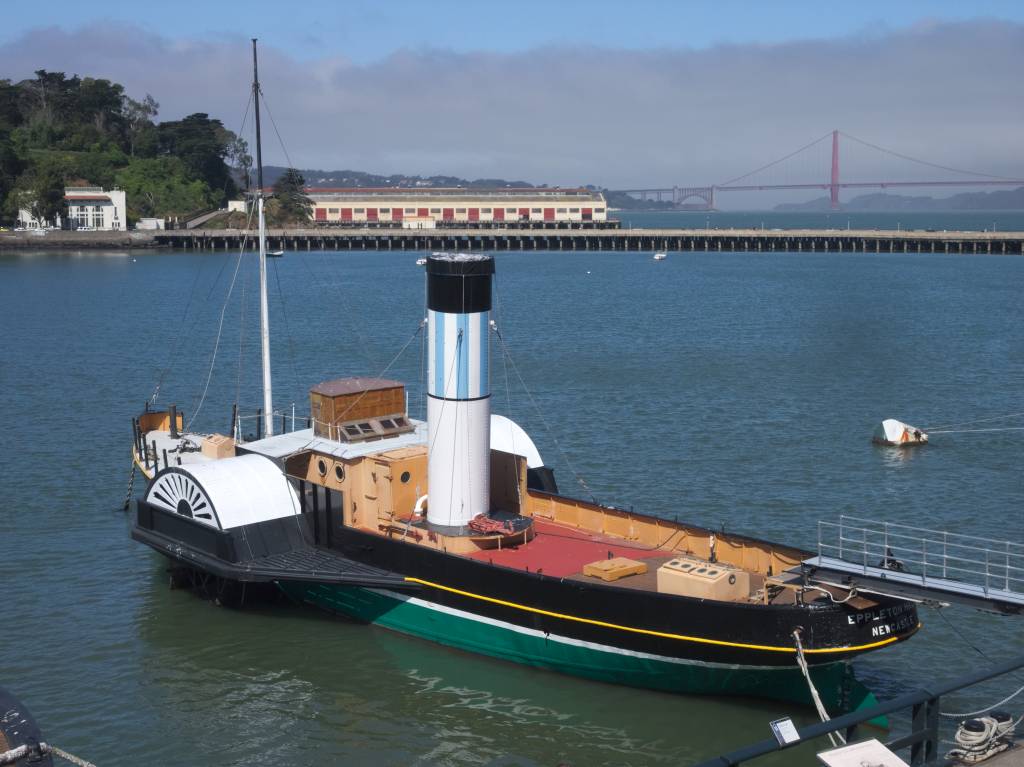
The Historical Park's collections include other vessels as well, like thid paddle-wheel tug.
The museum, also included in the Historical Park, was under renovation, but we could see some nice scale models in the lobby. This one depicts San Francisco harbor around the 1849 gold rush. The sailing vessel Niantic had arrived from the U.S. East Coast, sailing around Cape Horn. The owners decided to convert it to a shop and tavern - at the time, the potential profit was greater than in shipping industry.
Another model featured the crew in masts.
A few blocks away there's a Liberty-class freight steamer Jeremiah O'Brien, built during the Second World War. She's not a part of the Historical Park but ran by an association. She is seaworthy and in navigable condition, and does sail every now and then. In her hold visitors can see an exhibition on the Liberty ships, which were built for war material transports. Between 1941 and 1945, 2710 were built.
Liberty-class freighter Jeremiah O'Brien.
The telegrapher's cabin.
Fist mate's cabin. The radio equipment is not original but for the modern use of the ship.
The Jeremiah O'Brienin operational main engine.
The rescue ladder of the engine room. Would you want to climb this to escape a burning engine room after the ship has been hit by a torpedo?
There's another WWII vessel next to the Jeremiah O'Brien, the submarine USS Pampanito.
Fisherman's Wharf is probably the most touristy area of San Francisco and it is not my favorite place in the city. The museum ships are great, but in addition to them there are mostly plastic, overpriced theme restaurants and souvenir shops. However, there is one more reason to visit the Fisherman's Wharf: The sea lion colony on Pier 39. Jolly creatures. Smelly, though.
Every now and then one should show off for the tourists...
The United States are promised land of private cars, and public transport is not always very functional. Some bigger cities, like New York and San Francisco, are an exception to this, with their very good transport systems. The one in and around San Francisco, while functional, is a bit complicated, with several operators and several different rail networks. Thankfully, Clipper card is accepted as payment across network. In addition to modern buses, trams and BART trains, there are early 20th century style transport available.
A cable car arrives at Market Street terminus.
The Cable Cars are probably the most famous way of transport in San Francisco. The car itself is not equipped with an engine at all: the traction is provided by moving steel cables underground, below the track. When leaving a stop, the driver, known as gripman, applies a mechanical switch to grip the cable and get the car moving. When stopping, he releases the grip and applies brakes to stop the car (a more detailed explanation provided by the Cable Car Museum).
Compared to more modern trams and trains, riding the Cable Car is, unsurprisingly, uncomfortable and bumpy. Its is also quite expensive, since the cars, being one of San Francisco's symbols, are very popular among tourists. That said, they are well worth experiencing, if only to observe the gripman's actions. I recommend riding a Cable Car to the Cable Car Museum. It is in a working Cable Car power station, and one can observe the cable-operating equipment at work (see video below),
There are, of course, old Cable Cars in the Cable Car Museum.
The tram line F is a regular San Francisco tram line, with frequent schedules, but it is operated exclusively by vintage equipment, more than 50 years old trams. Most cars are painted in vintage liveries from different cities across the United States, and even Mexico City and Milan. I noticed that one detail was omitted from the cars painted in the colors of Birmingham, Alabama: the markings that separated the compartments for "white" and "colored" people.
Despite their age, the F-line cars are equally comfortable - if not more - as the modern ones. There is no extra cost for riding the vintage trams on the F-line, any regular tickets valid on San Francisco Municipal Transportation Agency (MUNI) buses, trains and trams are good.
This PCC car used on the F-line is painted in a livery used in Los Angeles.
Here I was born, and there I died. It was only a moment to you. You took no notice." - Alfred Hitchcock's Vertigo, 1958.
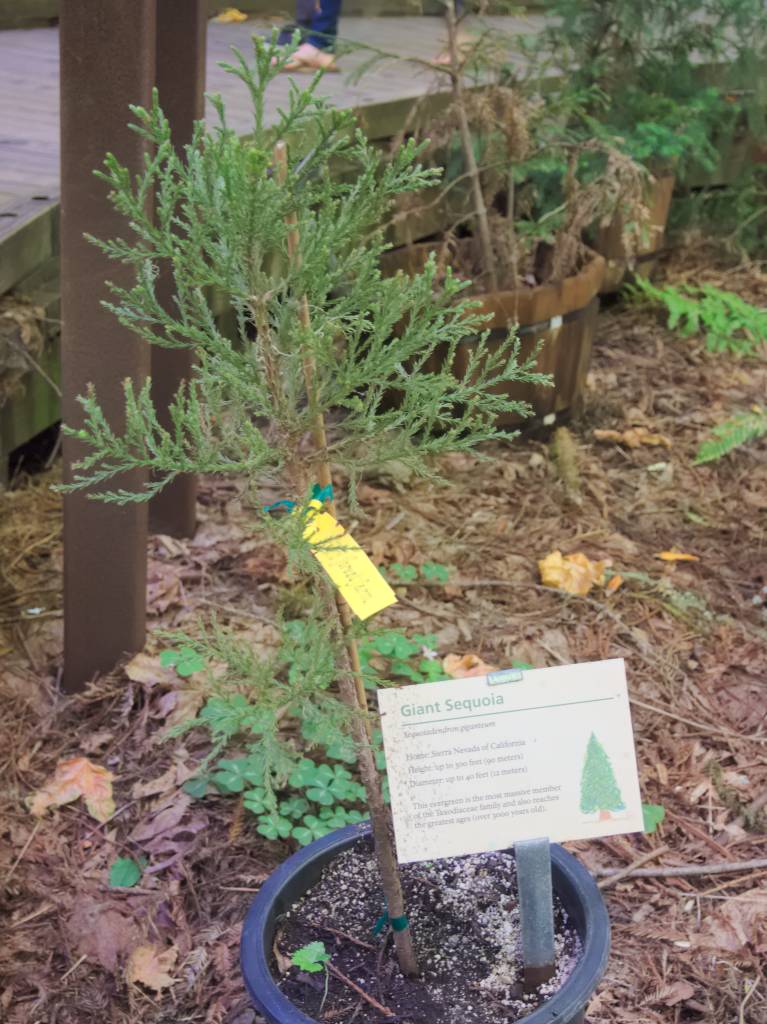
There is a lot of forest in Finland. Consequently, it may seem surprising that Finnish tourists travel all the way to California and go to see some trees. However, everything is bigger in America, including trees. The highest tree species of the world, California Redwood, and the biggest by volume, Giant Sequoia, grow in California. These are the biggest living creatures of the world, and among the oldest. Oldest living Giant Sequoia is about 3200 years old.
The very tallest trees are elsewhere, but you can see some really big ones in Muir Woods, too.
Yeah, they're tall.
The closest place to San Francisco to see these giant trees isMuir Woods National monument, one of the sites ran by the excellent National Park Service. Even for people who enjoy other things more than the Great Outdoors, Muir Woods is easily accessible: there are good signposted walk routes and information boards.
"When I grow up, I'll become a 100-meter Giant Sequoia".
The only drawback is common to many other U.S. National Parks: the place is a bit too popular. The footpaths get crowded, and the tourist hordes are sometimes unnecessarily loud. In Muir woods there were even signposts asking the visitors to be quiet in order not to disturb wildlife, but unfortunately many - I would say most - visitors ignored them. We visited on a Monday, but the site was very crowded, parking lots full and a lot of cars were parked dangerously by the narrow mountain road. We would advise against visiting on a weekend, if at all practical. Muir Woods is not the only place to see giant trees in California and the U.S. West Coast. Another popular spot is Wavona in Yosemite National Park. Muir woods is, however, one of the few Redwood and Sequoia forests practically accessible by public transport.
The overall ambience in the forest is tranquil, in spite of all the visitors.
Getting to places on public transport is sometimes laborious in the USA. Trip from San Francisco to Muir Woods is not particularly difficult, but it is slow, it may take more than two hours from city center and one should be prepared to wait when changing buses. From central San Francisco, first take a bus over Golden Gate Bridge to Sausalito or Marin City (for example bus number 70), or a ferry to Sausalito. Then take minubus 66 or 66F (only from April to October, timetables here) to Muir Woods. At least one can pay by Clipper Card in all buses and ferries.
If you're lucky you may see a traditional hippie VW bus when waiting for the bus.
Sausalito is a nice place to stop for a meal or ice-cream, there are a lot of options. Prices are on the expensive side but small town ambience is peaceful and relaxed. The sporty ones - not us! - may want to rent a bicycle from San Francisco: the ride to Muir Woods is demanding, long and hilly, but the views are great.
Oakland Museum of California, or OMCA, is one of the most pleasant museums I've ever visited (and I've visited quite a few). If you generally like museums, go to OMCA. If you generally do not like museums, go to OMCA still. If you can, go there on a Friday night, when tickets are half-price (free for everyone under 18), there's live music on the courtyard, street food for sale from food carts as well as beer and wine from local small producers, and themed guided tours in the exhibitions. Not surprisingly, there were a lot of people of all ages and the mood was generally very relaxed and good.
Because one always has to have some complaints, I complain about the queues to the food carts.
Even if you are not in Oakland on a Friday night, OMCA is well worth visiting. The permanent historical exhibition is well designed and executed, covering a very wide range of subjects but compact enough to be comprehensible and not overwhelming. I was particularly impressed by the way the exhibition deals with the history and experience of "common people" and their stories. For example the sections dealing with Native American peoples of California and social history of 1960s and 70s were created co-operatively with local residents and communities, showcasing everyday stories of ordinary people in an interesting and engaging way. In addition to the historical exhibition, there are also natural history and temporary themed exhibitions.
In OMCA, the Native Americans tell their own stories.
Local memories from 1960s, many people from Oakland seem to remember it as a dark and violent decade.
Ronald Reagan's poster for the 1968 Republican party presidential candidate race. That time, he lost.
During the Great Depression of late 1920s and early 30s many people from th American Midwest went to California to look for a better life. They often rode overloaded T-model Fords like this one.
Many things are invented in California, for example portable computer.
OMCA isn't afraid of dealing with difficult matters.
We visited OMCA on June 26th 2015, on a Friday night.